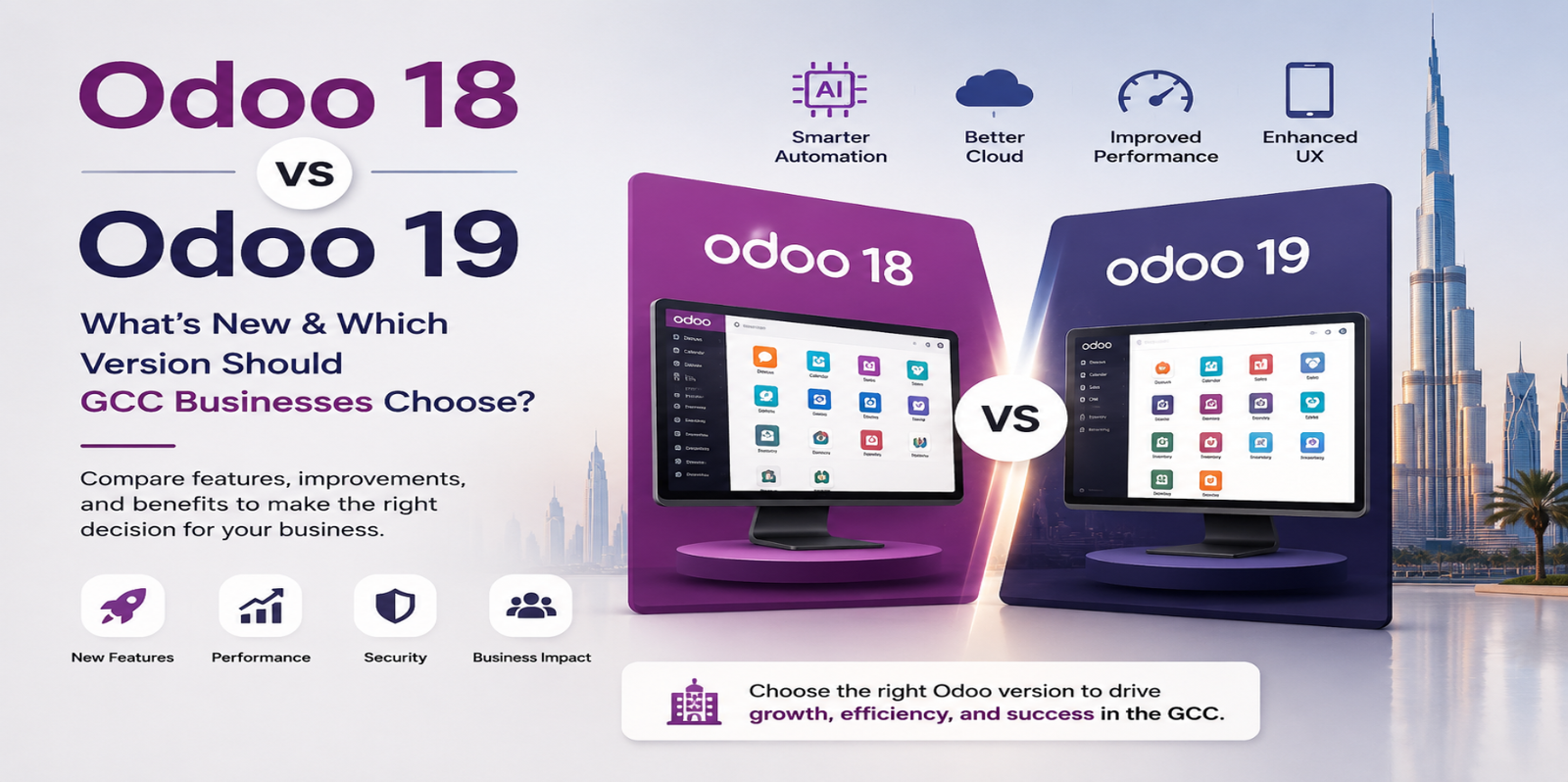

If you are running a business in Kuwait, Saudi Arabia, UAE, Bahrain, Qatar, or Oman and currently evaluating your ERP options, the Odoo 18 vs Odoo 19 comparison is one of the most important decisions on your roadmap right now.
Odoo 18 was released in October 2024 during the Odoo Experience event in Brussels, Belgium. Odoo 19 followed in September 2025 at the same annual event. With both versions now available, businesses partnering with a certified Odoo ERP provider in Kuwait need to understand what each version delivers before committing to an implementation or upgrade.
What Changed from Odoo 17 to Odoo 18?
Odoo 18 marked a significant step forward from earlier versions. The release focused on three core pillars: performance, user experience, and localization.
Businesses upgrading from Odoo 16 or Odoo 17 to Odoo 18 gained a noticeably faster interface, improved multi-currency accounting, and stronger Arabic localization support, particularly relevant for the GCC market where bilingual operations are standard.
Key Odoo 18 improvements over earlier versions included the following:
Accounting and Finance
Odoo 18 introduced improved bank reconciliation, smarter tax handling, and enhanced VAT reporting tools, critical for businesses in Kuwait, Saudi Arabia, UAE, and Bahrain operating under local tax compliance frameworks.
Inventory Management
Odoo 18 improved warehouse workflows with better stock forecasting, multi-step routing enhancements, and more transparent product availability displays, directly addressing pain points that businesses on Odoo 16 and 17 regularly reported.
POS Updates
Odoo 18 brought a cleaner point-of-sale interface with better bundle management and faster session handling, benefiting restaurants, retail stores, and service counters across the GCC.
API Improvements
Odoo 18 strengthened its API layer, making third-party integrations more reliable for businesses connecting Odoo to eCommerce platforms, delivery apps, and custom business tools.
For businesses in Kuwait and the GCC still running Odoo 15 or 16, upgrading to Odoo 18 alone represents a substantial operational improvement. If you are considering this path, Merak Tech’s Odoo ERP implementation services in Kuwait cover full migration, data transfer, and post-launch support.
What Does Odoo 19 Add on Top of Odoo 18?
Odoo 19, released in September 2025 at Odoo Experience 2025, introduces a range of new features, UX enhancements, localization improvements, and enhanced AI integration.
For GCC businesses evaluating the latest Odoo version, here is what matters most:
AI Everywhere — The Biggest Leap Forward
Odoo 19 is the inaugural version to seamlessly incorporate AI throughout its applications. AI assistants can generate content, compose emails, create product summaries, and give recommendations on next steps.
This is not a bolt-on feature. AI is embedded across sales, accounting, inventory, HR, and customer support modules, making Odoo 19 the most intelligent ERP release the platform has produced.
Odoo 19 Inventory Management Features
Odoo 19 improves inventory workflow with custom serial numbers, enhanced availability display, and improved stock logic, plus better handling of stock between companies and sales orders.
For supermarkets, distributors, and manufacturing businesses across Kuwait, Saudi Arabia, and the UAE, these changes directly reduce stock discrepancies and improve order fulfillment accuracy.
Odoo 19 Accounting Module Features
Odoo 19 allows checking the status of amounts still outstanding after a company’s financial year-end, and the Journal and Reconciliation models’ form views have been revamped.
Combined with a localized chart of accounts and full text search, Odoo 19 makes it significantly easier for accountants and finance teams in Kuwait and Bahrain to close books faster and audit with confidence.
Best Recurring Billing Software Capabilities
Odoo 19 enhances its subscription and recurring billing engine, making it one of the most capable recurring billing systems available inside an open-source ERP.
Businesses offering SaaS products, maintenance contracts, or subscription services across Kuwait, UAE, Qatar, and Oman will find the upgraded billing automation reduces churn from missed renewals and billing errors.
Simple Warehouse Management System Upgrades
Odoo 19 makes the handling of packaging units much easier, merging UoM and packaging systems for simpler warehouse workflows.
For businesses that previously found Odoo’s warehouse module complex, this simplification makes Odoo 19 far more accessible as a simple warehouse management system for small and mid-sized businesses in the GCC.
Cloud MRP Software Improvements
For manufacturers and production businesses, Odoo 19’s cloud MRP software capabilities receive meaningful upgrades, with better production scheduling, improved BoM (Bill of Materials) management, and enhanced integration between sales orders and manufacturing workflows.
This directly benefits industrial and manufacturing businesses in Saudi Arabia, UAE, and Oman looking to modernize operations.
Odoo 18 vs Odoo 19 — Which Should GCC Businesses Choose?
| Feature | Odoo 18 | Odoo 19 |
|---|---|---|
| AI Integration | Limited | Deep AI across all modules |
| Accounting | Strong, improved VAT | Enhanced reconciliation + audit tools |
| Inventory | Improved forecasting | Custom serials + better stock logic |
| Recurring Billing | Standard | Enhanced subscription automation |
| Warehouse (MRP) | Multi-step routing | Simplified UoM + packaging |
| POS | Cleaner interface | Dark Mode + bundle improvements |
| Arabic/GCC Localization | Good | Expanded (50+ countries) |
| Stability | Mature, well-tested | Still maturing (released Sept 2025) |
The verdict for GCC businesses:
- If you are currently on Odoo 15, 16, or 17, upgrading to Odoo 18 is the immediate priority. It is stable, well-tested, and delivers major improvements over older versions.
- If you are already on Odoo 18 and planning your next move, Odoo 19 is worth evaluating now, particularly if AI automation, inventory simplification, or advanced accounting are strategic priorities for your business in Kuwait, Saudi Arabia, UAE, Bahrain, Qatar, or Oman.
- The right version is always the one that matches your current operational maturity, your team’s readiness for change, and the support capability of your local Odoo implementation partner in Kuwait.
Odoo 19 vs Odoo 20 — What’s Next?
Following Odoo’s annual release cycle, Odoo 20 is expected around mid-September 2026.
For businesses planning a multi-year ERP roadmap, this means Odoo 19 will have approximately 12 months of active development before the next major release, a healthy window for stable adoption across Kuwait and the GCC.
Contact us for a free consultation today
Frequently Asked Questions
Q1. What is the Odoo 18 release date?
Odoo 18 was released in October 2024 during the Odoo Experience event in Brussels, Belgium.
Merak Tech, as a certified Odoo partner in Kuwait, supports businesses across Kuwait, Saudi Arabia, UAE, Bahrain, Qatar, and Oman in upgrading to and implementing Odoo 18.
Q2. What is the Odoo 19 release date?
Odoo 19 was released in September 2025 at Odoo Experience 2025.
It is currently the latest Odoo version available, offering AI integration, improved accounting, enhanced inventory management, and upgraded POS features for businesses across Kuwait, Saudi Arabia, UAE, Bahrain, Qatar, and Oman.
Q3. What are the key Odoo 19 new features?
Odoo 19 introduces AI integration across all modules, enhanced bank reconciliation, a redesigned journal form view, improved inventory workflows, and expanded localization across 50+ countries, making it one of the most capable Odoo versions for GCC businesses.
Q4. What are the Odoo 19 inventory management features?
Odoo 19 improves inventory with custom serial numbers, enhanced availability display, improved stock logic, and better handling of stock between companies and sales orders.
These features directly benefit supermarkets, distributors, and warehouse operators across Kuwait, UAE, Saudi Arabia, Bahrain, Qatar, and Oman.
Q5. What are the Odoo 19 accounting module features?
Odoo 19 features a revamped Journal and Reconciliation form view, an Open On Date feature for year-end accuracy checks, and improved document digitization that allows selecting text portions to fill form fields automatically.
These enhancements make auditing and financial operations faster for finance teams in Kuwait and the GCC.
Q6. What Odoo news is relevant for GCC businesses in 2025 and 2026?
The biggest Odoo news for GCC businesses is the release of Odoo 19 in September 2025, the first version to seamlessly incorporate AI throughout all its applications, and the expected release of Odoo 20 in September 2026.
Q7. What are the Odoo 19 release notes covering for POS businesses?
Odoo 19 POS release notes include a cleaner interface, customizable presets, dark mode, improved product bundle support, refunds via payment terminal, and integration of Glory ATMs and meal vouchers.
These improvements benefit restaurants and retail POS operators in Kuwait, UAE, Saudi Arabia, and Bahrain.
Q8. Is Odoo a good simple warehouse management system for small businesses in Kuwait?
Yes. Odoo 19 simplifies warehouse management by merging the Unit of Measure and packaging systems into a unified workflow, making it a practical and simple warehouse management system for small and mid-sized businesses in Kuwait, UAE, Saudi Arabia, Qatar, Bahrain, and Oman.
Q9. Is Odoo the best recurring billing software for subscription businesses in the GCC?
Odoo 19 is among the best recurring billing software options within an open-source ERP, combining automated subscription renewals, invoice generation, and payment reminders in one platform.
Merak Tech implements Odoo’s billing module for subscription businesses across Kuwait, UAE, Saudi Arabia, Qatar, Bahrain, and Oman.
Q10. What is the best cloud MRP software for manufacturers in Kuwait and the GCC?
Odoo is widely adopted as cloud MRP software for manufacturers across Kuwait, UAE, Saudi Arabia, Bahrain, Qatar, and Oman.
Odoo 19 improves MRP with better production scheduling, Bill of Materials management, and tighter integration between sales orders and manufacturing workflows, all managed via a cloud-based dashboard.