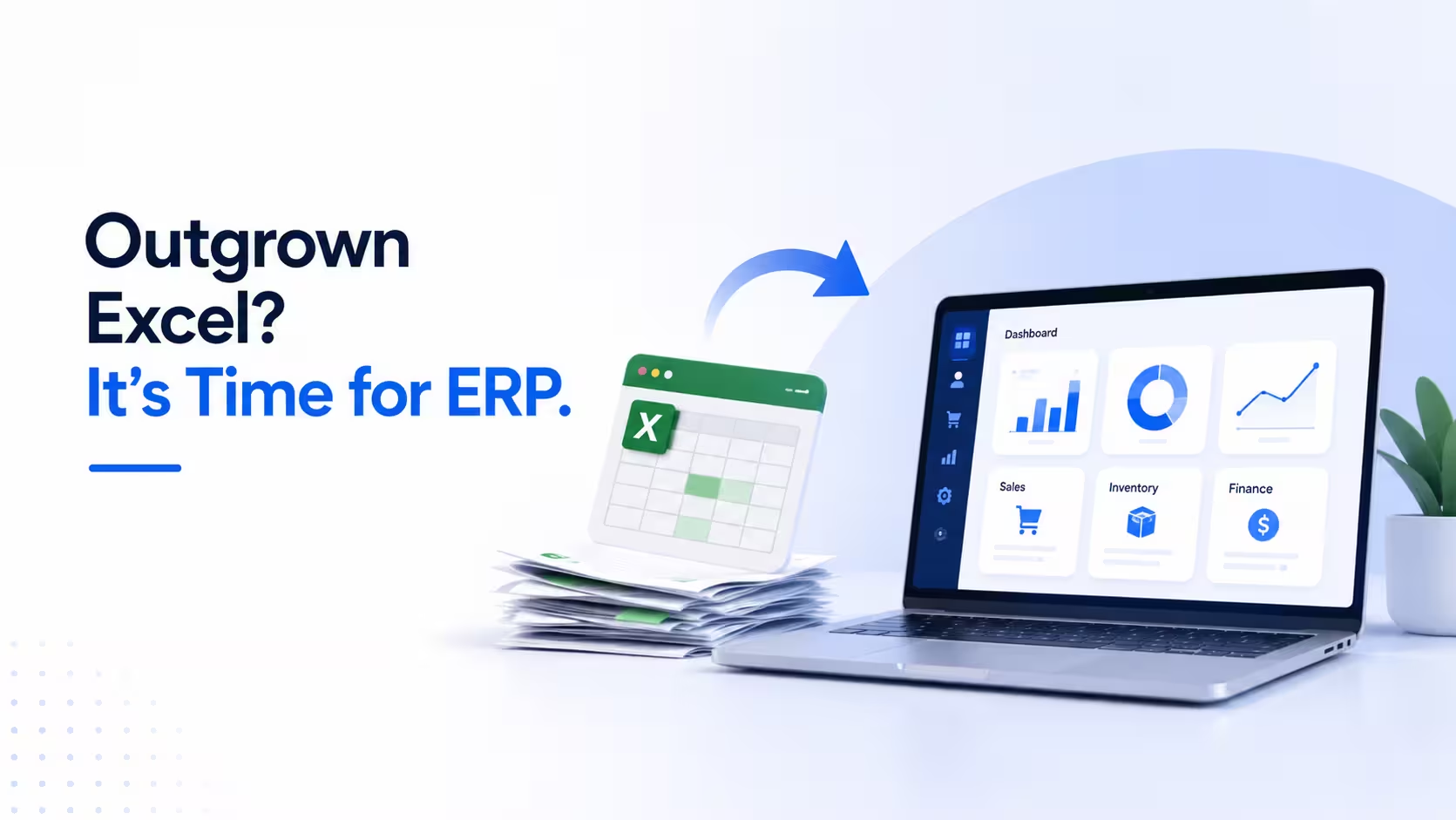

Excel is incredibly useful.
For a small business, it can be a simple and affordable way to track sales, expenses, inventory, employees, and customer information.
But as your business grows, Excel can start becoming less of a solution and more of a limitation.
More employees. More customers. More transactions. More branches.
Suddenly, you’re managing dozens of spreadsheets, sending files back and forth, correcting formulas, and trying to figure out which version contains the latest information.
If this sounds familiar, your business may have outgrown Excel.
An ERP system can help bring your operations together, automate repetitive processes, and give you a single source of truth for your business.
Here are five signs that it may be time to make the move.
1. You’re Managing Too Many Spreadsheets
One spreadsheet for sales.
Another for inventory.
Another for expenses.
Another for employees.
Another for purchasing.
And maybe another one that combines everything.
The problem isn’t Excel itself.
The problem is having too many disconnected files containing important business information.
When different departments maintain their own spreadsheets, information can quickly become inconsistent.
Someone updates one file but forgets another.
A manager works with yesterday’s numbers.
Finance has one figure while operations has another.
An ERP system connects these processes so everyone can work with the same up-to-date information.
2. Your Team Is Spending Too Much Time Entering Data
Ask your team how much time they spend copying information from one system or spreadsheet to another.
The answer may surprise you.
For example:
Sales order → Excel → Inventory update → Accounting → Invoice → Management report
If every step requires manual data entry, you’re paying employees to move information instead of focusing on more valuable work.
An ERP can automate the flow of information between departments.
When a sales transaction happens, the relevant inventory, accounting, and reporting information can be updated automatically.
Less repetitive work.
Fewer manual errors.
More time for your team.
3. You Don’t Have Real-Time Visibility
One of the biggest problems with spreadsheets is that they usually show you what happened—not necessarily what is happening right now.
Imagine you’re running a business with several branches.
You want to know:
- Which branch is performing best?
- How much inventory is available?
- Which products are selling fastest?
- What are your current expenses?
- How much money is outstanding?
- Which suppliers need to be paid?
- What is your actual profitability?
If your team needs to collect information from multiple spreadsheets before answering these questions, you don’t have real-time visibility.
An ERP provides centralized dashboards and reporting so decision-makers can access the information they need much faster.
4. Your Business Is Growing More Complex
Growth is a good thing.
But growth also creates complexity.
You may start with one location and eventually have five.
You may begin with ten employees and grow to fifty.
Your product range increases.
Your suppliers increase.
Your customer base expands.
Your accounting becomes more complicated.
The processes that worked when you were small may no longer work efficiently at your current size.
This is one of the clearest signs that your business needs an ERP system.
An ERP is designed to scale with your organization and connect different departments as your operations become more complex.
5. You’re Making Decisions Based on Outdated Information
This is perhaps the biggest warning sign.
If management has to wait until the end of the week or month to understand what’s happening in the business, you’re making decisions with incomplete information.
Imagine discovering at the end of the month that:
- A product was overstocked.
- A branch was losing money.
- Operating costs increased significantly.
- A supplier’s prices changed.
- Sales dropped in an important category.
By the time you discover the problem, the opportunity to act may already be gone.
An ERP helps provide more timely information, allowing management to identify problems earlier and make better decisions.
Excel Isn’t the Problem
It’s important to be clear about this.
Excel isn’t bad.
In fact, Excel remains an excellent tool for analysis, calculations, planning, and many day-to-day tasks.
The problem starts when a business uses spreadsheets as its primary system for managing increasingly complex operations.
When your spreadsheets become mission-critical, heavily interconnected, and difficult for anyone else to understand, that’s usually a sign that your business needs a more structured system.
What Can an ERP System Manage?
A modern ERP system can connect many areas of your business in one platform.
Depending on your requirements, this can include:
- Accounting and Finance
- Sales
- CRM
- Inventory
- Purchasing
- Human Resources
- Payroll
- Manufacturing
- Project Management
- Expense Management
- Reporting and Analytics
Instead of each department operating independently, information can flow between them.
For example:
Sales → Inventory → Purchasing → Accounting → Reporting
This creates a much more connected business environment.
The Benefits of Moving from Excel to ERP
Moving to an ERP isn’t about eliminating every spreadsheet.
It’s about putting your critical business processes into a system designed to manage them properly.
Businesses can benefit from:
Better Data Accuracy
Reduce duplicate data entry and manual errors.
Centralized Information
Keep important business information in one connected system.
Improved Productivity
Automate repetitive processes and reduce administrative work.
Real-Time Reporting
Give management faster access to business performance information.
Better Collaboration
Allow departments to work from the same information.
Easier Business Scaling
Create processes that can grow with your organization.
When Should You Move to an ERP?
There isn’t a specific number of employees or branches that tells you when it’s time.
The better question is:
Is your current system making your business harder to manage?
If your team is constantly:
- Updating spreadsheets
- Reconciling data
- Searching for information
- Fixing manual errors
- Creating reports manually
- Copying data between systems
- Waiting for information from other departments
then it may be time to consider an ERP.
Waiting until your business becomes completely overwhelmed can make the transition more difficult.
Planning ahead is usually better.
Why MERAK Tech?
At MERAK Tech, we help businesses across Kuwait and the GCC move from disconnected processes to integrated business systems.
Our ERP solutions are designed around the way your business actually works—not simply around a list of software features.
We help businesses with:
- ERP Consulting
- Odoo ERP Implementation
- ERP Customization
- Accounting Integration
- Inventory Management
- CRM
- HR & Payroll
- Business Process Automation
- Multi-Branch Management
- Reporting & Analytics
- ERP Integration
The goal is simple:
Make your business easier to manage, easier to scale, and easier to understand.
Final Thoughts
Your business doesn’t need an ERP simply because it’s growing.
It needs an ERP when the complexity of your operations starts exceeding what your current tools can comfortably handle.
If your team is spending more time maintaining spreadsheets than managing the business, that’s a warning sign.
If different departments have different versions of the truth, that’s another.
And if management can’t get reliable information quickly, it’s probably time to rethink your systems.
Excel can help you start a business. The right ERP can help you scale one.
At MERAK Tech, we help businesses evaluate their current processes and determine whether an ERP is the right next step.
Think your business has outgrown Excel? Let’s talk.
Visit almerak.com to explore ERP solutions for your business.
Frequently Asked Questions
What is an ERP system?
An ERP (Enterprise Resource Planning) system is business software that connects different departments and processes—such as accounting, sales, inventory, purchasing, HR, and CRM—within one centralized platform.
Is ERP better than Excel?
ERP and Excel serve different purposes. Excel is excellent for calculations, analysis, and smaller tasks, while ERP is designed to manage interconnected business operations at scale.
When should a business switch from Excel to ERP?
Businesses should consider ERP when spreadsheets become difficult to manage, departments rely on disconnected data, manual data entry consumes significant time, or management lacks real-time visibility.
Can an ERP replace all Excel spreadsheets?
Not necessarily. Businesses can continue using Excel where it adds value. The goal is to move critical operational processes into a structured system while keeping Excel for tasks where it is most useful.
Can MERAK Tech help with Odoo ERP implementation?
Yes. MERAK Tech provides Odoo ERP consulting, implementation, customization, integration, and ongoing support for businesses in Kuwait and the GCC.