
How a Centralized Business Management System Helps Multi-Branch Businesses Improve Efficiency
Managing a growing business isn’t just about increasing sales—it’s about maintaining control as operations become more complex.
As businesses expand across multiple branches, brands, and sales channels, managing everything through disconnected software quickly becomes a challenge.
Orders arrive from different platforms.
Inventory is managed separately.
Delivery partners use different systems.
Marketing operates independently.
Reports come from multiple sources.
Before long, managers spend more time reconciling data than making business decisions.
This is where a Centralized Business Management System transforms the way organizations operate.
The Hidden Cost of Disconnected Systems
Many successful businesses don’t struggle because of poor products or weak customer demand.
They struggle because their operations have become fragmented.
Different departments use different software.
Information is duplicated.
Reports don’t match.
Employees spend hours manually updating spreadsheets.
These hidden inefficiencies affect every part of the business.
Common challenges include:
- Duplicate data entry
- Disconnected reporting
- Manual reconciliation
- Inventory inaccuracies
- Delayed decision-making
- Poor communication between departments
- Higher operating costs
- Limited visibility across branches
As businesses grow, these challenges become even more difficult to manage.
When Growth Creates Complexity
Imagine a food and beverage company operating multiple brands across numerous locations.
Each branch receives orders from different channels.
Delivery platforms operate independently.
Marketing campaigns generate customer data that never reaches operations.
The ERP system contains financial information but lacks real-time operational visibility.
The business isn’t failing.
It’s simply working much harder than necessary.
Without connected systems, managers spend valuable time gathering information instead of improving performance.
The Need for One Connected Platform
The goal isn’t always to replace every existing system.
The smarter approach is often to connect them.
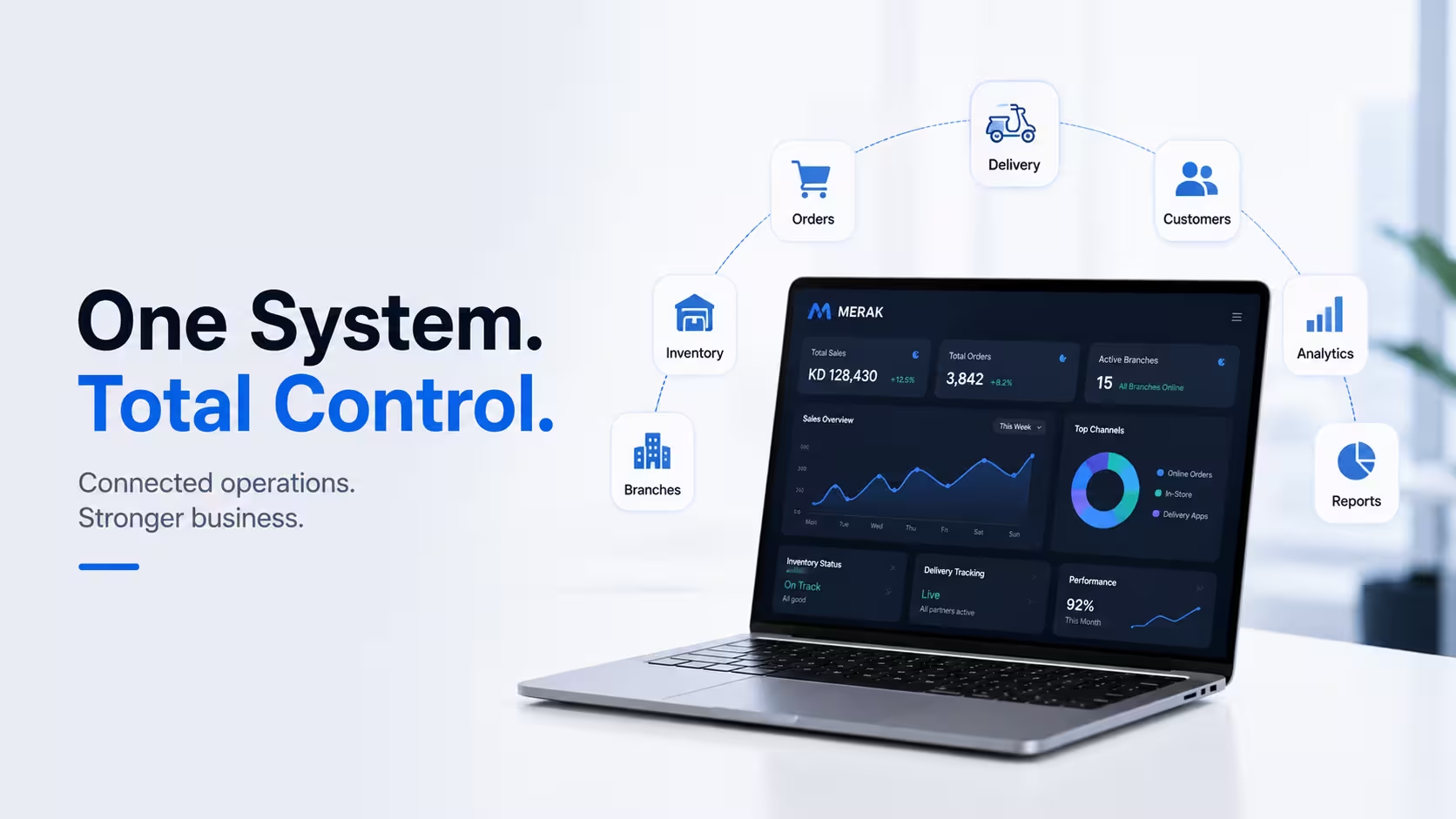
A Centralized Business Management System brings together multiple business functions into one unified platform.
Instead of switching between disconnected applications, business leaders gain one complete operational view.
Information flows automatically between departments, improving collaboration and reducing manual work.
What a Centralized Business Management System Can Do
A connected business platform helps organizations manage operations more efficiently by bringing together critical business functions.
These include:
- Sales Management
- Inventory Control
- ERP Integration
- Customer Relationship Management (CRM)
- Delivery Platform Integration
- Purchasing
- Financial Reporting
- Production Management
- Warehouse Operations
- Business Analytics
Rather than managing information separately, every department works from the same data.
Better Visibility Across Every Branch
For multi-location businesses, visibility is everything.
Managers need answers to questions such as:
- Which branch is performing best?
- Which products are selling fastest?
- Where is inventory running low?
- Which locations generate the highest profit?
- Which delivery channels perform best?
Without centralized reporting, answering these questions can take hours—or even days.
With an integrated platform, the information is available in real time.
Smarter Inventory Management
Inventory is one of the largest operating costs for many businesses.
Disconnected systems often lead to:
- Overstocking
- Understocking
- Food waste
- Expired inventory
- Inaccurate purchasing
- Production inefficiencies
A centralized platform provides real-time inventory visibility across every branch.
This allows businesses to forecast demand more accurately while reducing unnecessary waste.
Better Decisions Through Real-Time Data
Business decisions should be based on accurate information—not assumptions.
A centralized system provides live dashboards that help management monitor:
- Sales performance
- Inventory movement
- Customer trends
- Delivery performance
- Operational efficiency
- Branch profitability
- Financial performance
With access to reliable data, businesses can respond more quickly to changing market conditions.
Why Integration Matters
Many businesses already have an ERP system.
Others use separate POS software, CRM platforms, inventory applications, and marketing tools.
The challenge isn’t necessarily the software itself.
The challenge is that these systems often don’t communicate with one another.
Integration connects existing systems so information flows automatically.
Benefits include:
- Reduced manual work
- Improved reporting
- Better collaboration
- Faster decision-making
- Increased operational efficiency
- Greater data accuracy
Integration helps businesses maximize the value of the technology they already own.
Why Businesses Choose MERAK
At MERAK, we believe digital transformation starts with understanding how a business operates.
Instead of recommending unnecessary software, we focus on creating connected systems that solve real operational challenges.
Our expertise includes:
- ERP Integration
- Odoo ERP Implementation
- POS Solutions
- CRM Systems
- Restaurant Management Software
- Business Process Automation
- Custom Software Development
- AI Automation
- Multi-Branch Business Solutions
- Cloud Business Platforms
Every solution is designed to improve visibility, simplify operations, and support long-term business growth.
Final Thoughts
As businesses grow, complexity naturally increases.
The solution isn’t adding more software.
It’s connecting the systems you already use.
A Centralized Business Management System eliminates fragmented operations, improves visibility across every department, reduces manual work, and provides the real-time insights businesses need to grow with confidence.
The organizations that thrive tomorrow won’t necessarily be the ones with the biggest teams.
They’ll be the ones with the most connected operations.
If your team spends more time reconciling reports than running the business, it may be time to rethink how your systems work together.
Because better decisions begin with better data—and better data begins with connected systems.
Learn More
Discover how MERAK helps businesses across Kuwait and the GCC simplify operations through integrated business technology solutions.
https://www.almerak.com/
https://www.almerak.com/contact-us/
https://www.almerak.com/merak-tech-blogs/
Frequently Asked Questions
What is a Centralized Business Management System?
A Centralized Business Management System connects multiple business functions such as ERP, CRM, inventory, sales, finance, and reporting into one integrated platform.
Why do businesses need integrated systems?
Integrated systems reduce manual work, improve reporting accuracy, eliminate duplicate data entry, and provide real-time visibility across the business.
Can existing software be integrated?
Yes. In many cases, businesses can integrate their existing ERP, POS, CRM, and other applications without replacing every system.
Which businesses benefit from centralized management systems?
Multi-branch retailers, restaurants, hospitality groups, manufacturing companies, distributors, healthcare providers, and any business managing multiple departments or locations can benefit from a centralized system.