
Choosing the right business software can be confusing, especially when you’re comparing a POS system with an ERP system.
Both help businesses manage operations, but they are designed for different purposes.
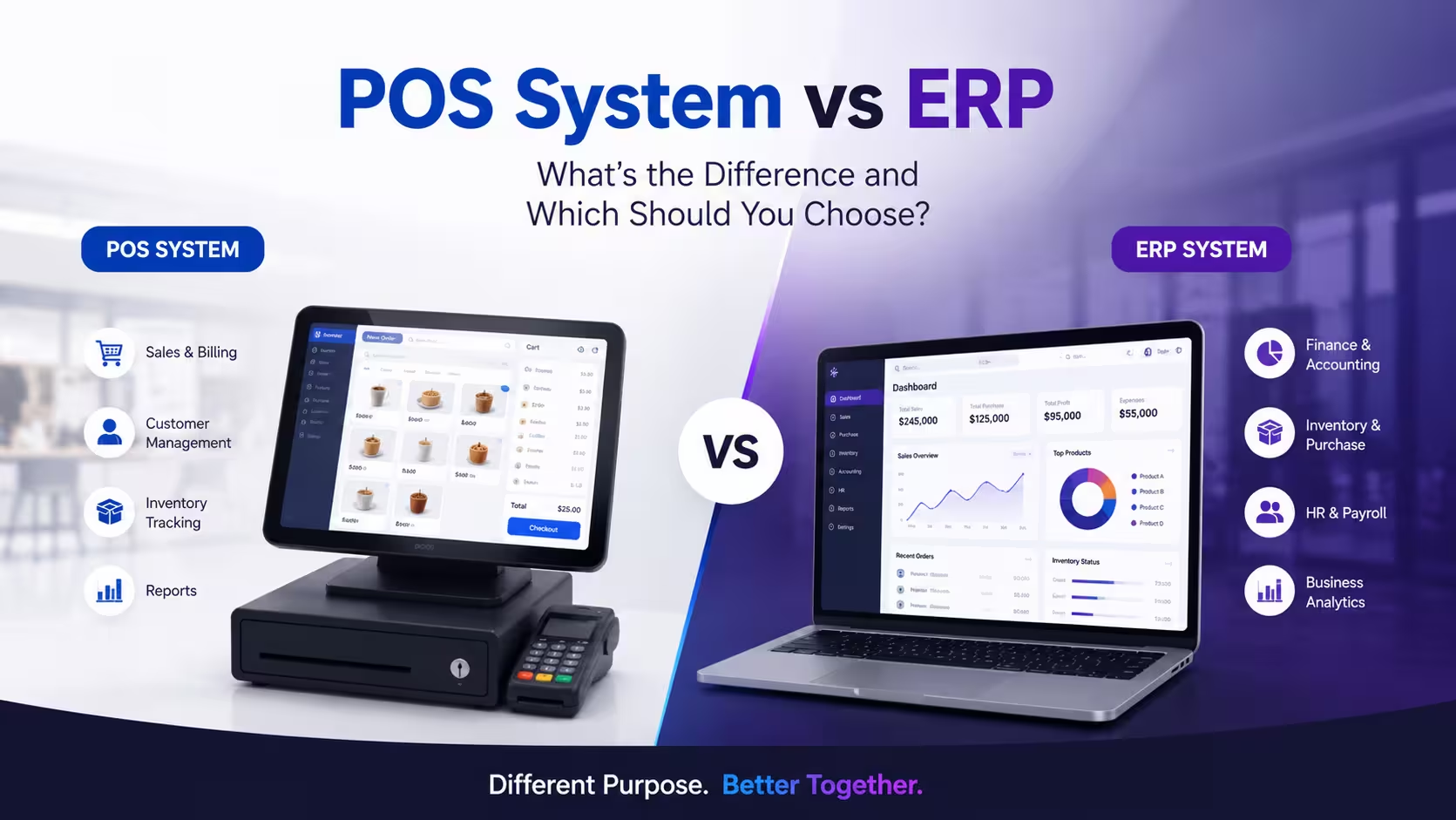
A POS is primarily focused on transactions, sales, customers, and day-to-day operations at the point of sale. An ERP, on the other hand, connects broader business functions such as accounting, inventory, procurement, HR, CRM, and reporting.
So, which one does your business need?
The answer depends on your business size, industry, operational complexity, and growth plans.
What Is a POS System?
A Point of Sale (POS) system is software that helps businesses process sales and manage activities related to customer transactions.
Modern POS systems do much more than simply print receipts.
Depending on the industry, a POS can help manage:
- Sales and billing
- Products and services
- Inventory
- Customer records
- Payments
- Discounts and promotions
- Sales reports
- Staff activity
- Multiple branches
For example, a restaurant may use a POS to manage dine-in, takeaway, delivery, kitchen orders, payments, and inventory from one system.
A retail store may use it for barcode scanning, checkout, stock tracking, customer loyalty, and sales reporting.
MERAK provides industry-specific POS solutions in Kuwait for restaurants, cafés, salons, spas, gyms, retail businesses, supermarkets, and other industries.
What Is an ERP System?
ERP stands for Enterprise Resource Planning.
An ERP system connects the wider functions of a business into one centralized platform.
Instead of managing finance, HR, purchasing, inventory, sales, and customer information through separate applications, an ERP allows businesses to manage these processes together.
An ERP can include:
- Accounting and finance
- Inventory management
- Purchasing
- Sales
- CRM
- Human resources
- Payroll
- Manufacturing
- Project management
- Reporting and analytics
For growing businesses, ERP provides a broader view of how different departments are performing and how they affect each other.
MERAK provides Odoo ERP solutions in Kuwait to help businesses connect their operations, improve workflows, and gain better visibility across their organization.
POS System vs. ERP: What Is the Difference?
The easiest way to understand the difference is to look at their primary purpose.
A POS system manages transactions and frontline operations, while an ERP manages the wider business.
| POS System | ERP System |
|---|---|
| Focuses on sales and transactions | Focuses on the entire business |
| Designed for frontline operations | Designed for multiple departments |
| Processes customer payments | Manages finance and accounting |
| Tracks sales and products | Manages procurement and inventory |
| Common in retail and restaurants | Common across growing and complex businesses |
| Provides sales reports | Provides company-wide reporting |
| Supports checkout and billing | Connects business processes |
The two systems are not necessarily competitors.
In many businesses, they work best together.
When Should You Choose a POS System?
A POS system may be the right starting point if your primary requirement is managing sales and daily customer transactions.
A POS is particularly useful for:
Retail Businesses
Retailers need fast checkout, barcode scanning, inventory tracking, product management, and sales reporting.
Restaurants and Cafés
Restaurants need to manage tables, orders, kitchen operations, payments, takeaway, delivery, and inventory.
Salons and Spas
Salons and spas can use POS software to manage appointments, services, customer records, billing, memberships, and staff activity.
Gyms and Fitness Centers
A specialized POS system can manage memberships, payments, attendance, trainers, and recurring billing.
If your main challenge is managing sales and operational transactions, a POS system may provide everything you need without the complexity of a full ERP.
When Should You Choose an ERP?
An ERP becomes more valuable when your business has multiple departments and increasingly complex processes.
You may need an ERP if you’re struggling with:
- Separate accounting and sales systems
- Manual inventory management
- Multiple spreadsheets
- Disconnected departments
- Complex purchasing processes
- Growing employee numbers
- Multiple branches
- Lack of centralized reporting
- Difficulty tracking business performance
For example, a growing distribution company may need sales, purchasing, inventory, accounting, CRM, and employee management to work together.
That’s where ERP becomes much more useful than a standalone POS.
Can a Business Use Both POS and ERP?
Absolutely.
In fact, integrating POS and ERP can be the ideal setup for many businesses.
The POS handles what happens at the customer-facing level.
The ERP manages what happens across the wider organization.
For example:
Customer places an order → POS processes the sale → inventory is updated → financial data is synchronized → accounting records the transaction → management sees the result in reports.
This creates a connected flow of information instead of requiring employees to manually transfer data between systems.
POS + ERP Integration: The Best of Both Worlds
Consider a restaurant with five branches.
The POS system handles:
- Customer orders
- Table management
- Kitchen orders
- Payments
- Discounts
- Daily sales
Meanwhile, the ERP manages:
- Accounting
- Purchasing
- Supplier management
- Inventory
- HR
- Payroll
- Financial reporting
When the two systems are integrated, information can flow between them automatically.
This reduces duplicate data entry and gives management a clearer picture of the business.
Why Integration Matters as Your Business Grows
A business might start with a simple billing system.
As sales increase, the company adds inventory software.
Then it adds accounting software.
Then CRM.
Then HR and payroll.
Before long, employees are working with five or six different systems.
The problem isn’t necessarily the number of tools.
The problem is when those tools don’t communicate.
Integration can help businesses create a more connected technology environment without necessarily replacing every system they already use.
Which Is Better: POS or ERP?
There isn’t a universal winner.
The better question is:
What problem are you trying to solve?
Choose a POS if you primarily need:
- Fast billing
- Sales management
- Inventory tracking
- Payment processing
- Customer management
- Branch-level operations
Consider an ERP if you need:
- Accounting
- Procurement
- HR and payroll
- CRM
- Company-wide inventory
- Multiple departments
- Advanced business workflows
- Centralized reporting
And if your business needs both frontline transaction management and centralized business management, POS + ERP integration may be the strongest option.
How MERAK Tech Can Help
Choosing software shouldn’t start with the question, “Which system is more popular?”
It should start with understanding how your business operates.
At MERAK Tech, we help businesses across Kuwait identify, implement, integrate, and customize the right technology for their operations.
Our solutions include:
- POS Systems
- Odoo ERP
- CRM Solutions
- Inventory Management
- HR & Payroll
- Business Automation
- Custom Software Development
- POS & ERP Integration
With more than 10 years of IT experience, MERAK focuses on building practical technology solutions around real business requirements.
Final Thoughts
A POS system and an ERP system serve different purposes.
A POS helps you manage transactions and frontline operations.
An ERP connects the broader business.
For smaller businesses with straightforward sales operations, a POS may be enough. As your organization grows and processes become more complex, an ERP can provide the centralized control and visibility you need.
For businesses that require both, integrating a POS with an ERP can create a powerful, connected technology ecosystem.
The right choice isn’t about buying the biggest system.
It’s about choosing the system that fits your business today—and can support where you want to go tomorrow.
Not sure whether your business needs a POS, ERP, or both? MERAK Tech can help you evaluate your requirements and recommend the right solution.
Frequently Asked Questions
Is a POS system the same as an ERP?
No. A POS primarily manages sales, billing, payments, and frontline operations, while an ERP connects broader business functions such as accounting, HR, purchasing, inventory, and CRM.
Can a POS system replace an ERP?
For some small businesses with simple operations, a POS may be sufficient. However, businesses with multiple departments or complex workflows generally benefit from ERP capabilities.
Can POS and ERP systems work together?
Yes. POS and ERP integration allows sales and operational data to flow into broader business processes such as accounting, inventory, purchasing, and reporting.
Which is better for a small business: POS or ERP?
It depends on the business. If your main requirement is sales and billing, a POS may be the better starting point. If you need to manage multiple departments and complex business processes, an ERP may be more appropriate.
Does MERAK provide both POS and ERP solutions?
Yes. MERAK provides POS solutions for multiple industries as well as Odoo ERP implementation and customization for businesses in Kuwait.