
IFRS taxonomy Kuwait compliance sits at the center of every Qayd XBRL filing, even though it rarely gets explained in plain terms. Most guides jump straight to “map your accounts to the taxonomy” without ever explaining what a taxonomy actually is. Here’s the plain-English version — what it is, how tagging works, and why getting this part right determines whether your filing gets accepted or bounced back.

What Is a Taxonomy, in Plain Terms?
Think of a taxonomy as a dictionary. It’s a predefined list of terms, definitions, and relationships that everyone using the system agrees to use the same way. So when one company tags a number as “Revenue” and another company tags theirs the same way, a computer reading both filings knows for certain those two numbers mean the exact same thing — not “probably the same” or “close enough.”
Without a shared taxonomy, XBRL wouldn’t work at all. Every company could invent its own labels, and the entire point of machine-readable, comparable financial data would collapse.
The IFRS Accounting Taxonomy Specifically
The taxonomy Qayd is built on is the IFRS Accounting Taxonomy, maintained by the IFRS Foundation. It’s a structured, XBRL-based representation of the disclosure and presentation requirements in IFRS Accounting Standards — essentially, IFRS itself translated into a format software can read and validate.
This isn’t unique to Kuwait. Regulators around the world use the same IFRS taxonomy as the base for their own XBRL filing systems, including the U.S. Securities and Exchange Commission for foreign private issuers reporting under IFRS, as documented on the SEC’s own taxonomy page. Kuwait adopting the same underlying structure through Qayd means the country’s reporting data speaks the same language as filings from dozens of other jurisdictions.
New to the topic? Start here: XBRL Qayd Kuwait: The Complete 2027 Compliance Guide
How XBRL Tagging Actually Works
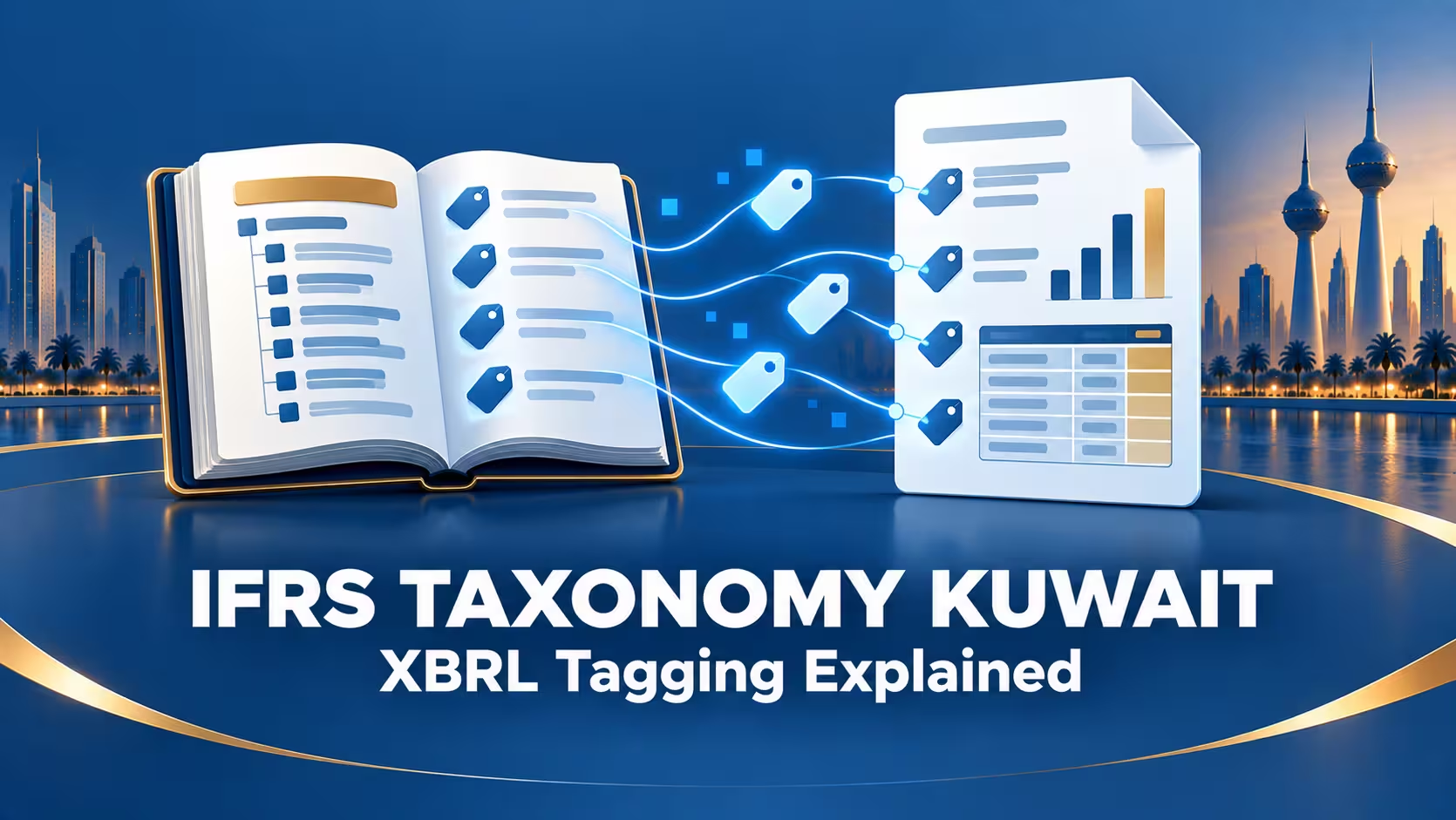
“Tagging” simply means attaching the correct taxonomy element to a specific number in your financial statement. Each element in the IFRS taxonomy carries a precise definition, so the tag isn’t just a label — it’s a claim about exactly what that number represents.
| What You See on a Statement | What Gets Tagged Behind It |
|---|---|
| “Total Assets: 500,000 KWD” | The specific IFRS taxonomy element for Total Assets, with the value 500000 |
| “Trade Receivables” | A distinct element from generic “Receivables,” classified as current or non-current |
| A note disclosure explaining a figure | Its own taxonomy element, linked back to the tagged number it explains |
This is also why generic “close enough” labeling causes rejections. Tagging “Trade Receivables” using the element meant for general “Receivables” isn’t a rounding error — it’s a different claim about what the number represents, and the Qayd portal’s validation is built to catch exactly that kind of mismatch.
Why Taxonomy Mapping Is the Hard Part
Most businesses don’t struggle with the concept of XBRL — they struggle with the mapping work itself. A typical chart of accounts wasn’t originally designed with a specific external taxonomy in mind, so every account needs to be reviewed and matched to the IFRS taxonomy element that most precisely represents it.
This is slower and more detailed work than it sounds, especially for businesses whose accounts were set up years ago with internal naming conventions that don’t map cleanly to standardized IFRS categories.
Read more: Chart of Accounts Mapping for XBRL Kuwait: Step-by-Step
How This Connects to Qayd Filing
When your accounting system generates an XBRL file for the Qayd portal, it’s the taxonomy mapping you’ve set up that determines whether the export is even possible, and the tagging accuracy that determines whether it passes validation once submitted. A system can technically “export XBRL” and still produce a file that gets rejected if the underlying mapping to the IFRS taxonomy elements isn’t accurate.
This is also why an Odoo XBRL module isn’t just a file-conversion tool—the module’s real job is managing this taxonomy mapping correctly, account by account.
Read more: Odoo XBRL Kuwait: Essential 5-Step Export Guide
Frequently Asked Questions
Is the IFRS taxonomy specific to Kuwait?
No—it’s a global standard maintained by the IFRS Foundation, used as the base for XBRL filing systems in many jurisdictions. Kuwait’s Qayd system builds on this same taxonomy rather than inventing its own from scratch.
Do I need to memorize taxonomy elements myself?
No. This is precisely the work an XBRL-capable accounting system or module is meant to handle—you shouldn’t need to manually look up taxonomy definitions for every account.
What happens if an account is mapped to the wrong taxonomy element?
It can cause the Qayd portal to flag or reject the filing during validation, since the system is checking that reported figures match the definitions of the elements they’re tagged with.
Where can I see the actual IFRS taxonomy structure?
The IFRS Foundation publishes the full taxonomy along with illustrative examples for how elements are meant to be applied.
Let Us Handle the Taxonomy Mapping
MerakTechmaps your chart of accounts to the correct IFRS taxonomy elements and configures Odoo to generate accurate, Qayd-ready XBRL filings.