
“Qayd-ready accounting system” is a phrase worth pausing on, because having accounting software and being Qayd-ready are not the same thing. A business can run a perfectly functional system for years—invoicing, payroll, and bank reconciliation all working fine—and still have no realistic path to producing what the Qayd portal actually requires: a validated XBRL instance document built on the IFRS taxonomy.
This is a practical, system-by-system look at where the most common platforms in Kuwait actually stand.

What “Qayd-Ready” Actually Requires
Three layers need to be in place together, not just one:
- IFRS-structured books. Your trial balance, balance sheet, and income statement need to already follow IFRS presentation—correct classification, consistent totals, and proper note structure. A system that just produces “a balance sheet” isn’t enough if it isn’t an IFRS balance sheet.
- Taxonomy mapping. Every line item needs to map to the correct tag in the Qayd XBRL taxonomy—the same way every product needs the right barcode, not just any barcode.
- A validated export. The system needs to actually generate the XBRL instance document and, ideally, catch inconsistencies (totals not matching sub-totals, opening balances not matching prior closing) before you submit—because the Qayd portal will catch them anyway, just later and more painfully.
A system can have layer 1 and still fail on 2 and 3. That’s the trap a lot of businesses fall into when they assume “we have real accounting software” automatically means “we’re Qayd-ready.”
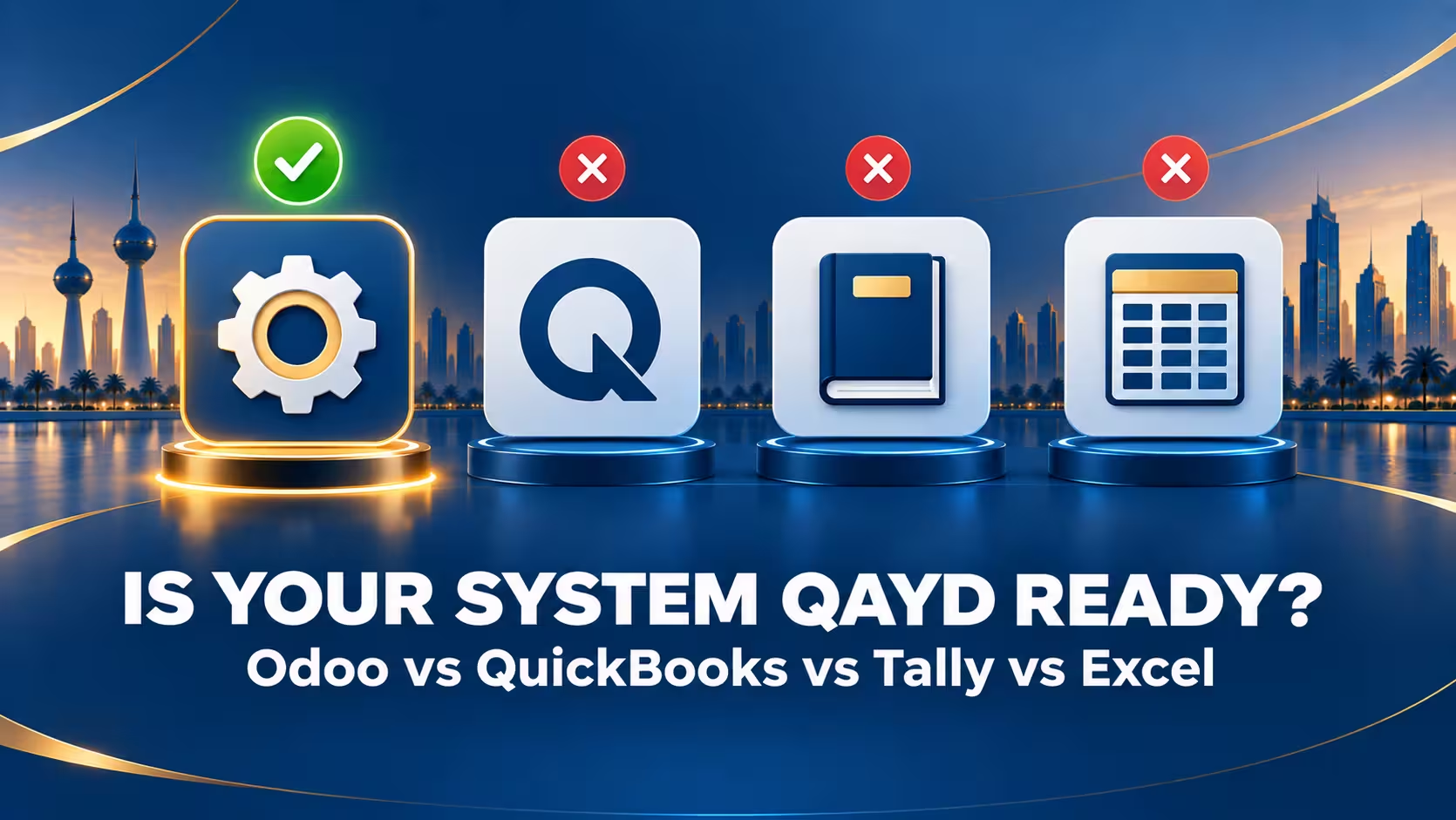
At a Glance: Where Each System Stands
| System | Qayd Readiness |
|---|---|
| Odoo | ✅ Ready with a dedicated XBRL module |
| QuickBooks | ❌ No native export |
| Tally | ❌ No native export |
| Excel | ❌ No realistic path at all |
| SAP Business One | ⚠️ Costly third-party add-ons only |
System by System
Odoo, configured for Kuwait IFRS — The accounting engine is IFRS-aligned by design, which covers layer 1 when implemented properly. XBRL export itself needs a purpose-built module mapping Odoo’s IFRS reports to the Qayd taxonomy—this is not a default feature of a generic Odoo install, and it needs to be configured by a partner who understands both Odoo and the Qayd taxonomy specifically.
QuickBooks—Does not produce IFRS-tagged XBRL output for Kuwait’s taxonomy. Businesses on QuickBooks are looking at either a third-party conversion tool re-run every filing period or a migration to a system built for this.
Tally—No native XBRL export. The re-keying workaround is slow, error-prone, and doesn’t scale—every filing period repeats the manual work and the risk.
Excel-based bookkeeping—effectively a non-starter. No structured chart of accounts, no IFRS reporting engine, no realistic path to a validated XBRL export without a full accounting system underneath it first.
Older SAP Business One installs—technically reachable via third-party add-ons, but the GCC XBRL add-on ecosystem for SAP B1 is thin, and the configuration cost is high relative to the size of business that typically runs it in Kuwait.
Curious how the Odoo module itself actually works? Read more: Odoo XBRL Kuwait: Essential 5-Step Export Guide
How to Check Where You Actually Stand
Don’t guess—run a short gap assessment:
- Export a full set of financial statements from your current system.
- Check them against IAS 1 presentation requirements—correct current/non-current classification, comparative periods, note disclosures.
- If they don’t already look like a proper IFRS statement, tagging is premature—fix the structure first, because XBRL tagging can’t repair statements that were never built to IFRS in the first place.
- If they do, the remaining question is purely technical: does your system (or an add-on to it) produce a validated Qayd-taxonomy export?
If You’re Not Ready
A realistic path for a business starting from Tally, QuickBooks, or Excel:
| Step | What Happens |
|---|---|
| Gap assessment | Confirm current statements aren’t IFRS-structured. |
| Migration | Move to an IFRS/XBRL-capable system—typically 6–10 weeks for a mid-size business. |
| Parallel run | Run the new and old systems side by side to validate before a full cutover. |
| Test filing | Submit a real filing to the Qayd portal during the voluntary window and fix any validation errors. |
| Go-live | File on time from 2027, with the tagging and validation issues already worked out |
All-in, a realistic timeline is 60 to 90 days. Starting that process now, during the voluntary window, means fixing problems on your own schedule. Starting it later in 2026 means fixing them under deadline pressure, during your busiest accounting period.
Read more: XBRL Implementation Cost and Timeline in Kuwait
Frequently Asked Questions
Is any accounting system fully Qayd-ready out of the box?
Not currently. Even Odoo, the strongest starting point, needs a dedicated XBRL module configured for the Qayd taxonomy—it’s not a default feature of a generic install.
Can I just export my QuickBooks reports as XBRL manually?
Not in a way that scales. Without native taxonomy mapping, you’d be manually tagging every line item each filing period, which is slow and error-prone at best.
Is Excel really unusable for this?
Yes, in practical terms. Excel has no structured chart of accounts or IFRS reporting engine, so there’s no realistic path to a validated XBRL export without a full accounting system underneath it first.
How do I know if my SAP Business One install can be extended?
It depends on which third-party add-ons are available and supported for your version — worth a direct technical assessment rather than assuming either way.
Find Out Where Your System Actually Stands
MerakTech runs a free gap assessment to check whether your current accounting system can produce a Qayd-ready XBRL file — and what it would take to get there.