
Odoo implementation Kuwait projects succeed or fail long before the software goes live. The difference is usually planning: clear scope, clean data, the right team and proper training. This step-by-step guide walks through the full implementation process for a Kuwait business, from the first discovery workshop to post go-live support, with the checklists and mistakes to watch for.
In this guide
- What Does an Odoo Implementation Involve?
- Before You Start: Decisions to Make First
- The 9 Steps of Odoo Implementation in Kuwait
- Who Should Be on the Project Team?
- What Matters Specifically in Kuwait
- Timeline and Cost: What Drives Them
- Common Mistakes
- How to Choose an Implementation Partner
- Frequently Asked Questions
- Final Thoughts

What Does an Odoo Implementation Involve?
Odoo is a modular business platform that covers accounting, sales, purchasing, inventory, CRM, manufacturing, HR, point of sale and more. An implementation is the project that turns it from a standard product into a system that fits how your company actually works.
That includes analyzing your processes, configuring the modules you need, importing your data, customizing where necessary, training your people and supporting you after go-live. A real Odoo implementation Kuwait businesses can rely on is a business project, not just an IT installation. You can explore the platform itself on the official Odoo website.
Before You Start: Decisions to Make First
| Decision | Why It Matters |
|---|---|
| Goals | Define what success looks like: faster month-end, better stock control, one view of sales and so on. |
| Scope | Which departments and modules go live first, and which can wait for phase two? |
| Edition | Community or Enterprise, which changes the features available. |
| Hosting | Cloud-hosted by Odoo, hosted by a partner, or on your own servers. |
| Owner | One internal project owner with authority to make decisions. |
| Existing systems | What you currently use, and what must be replaced or integrated. |
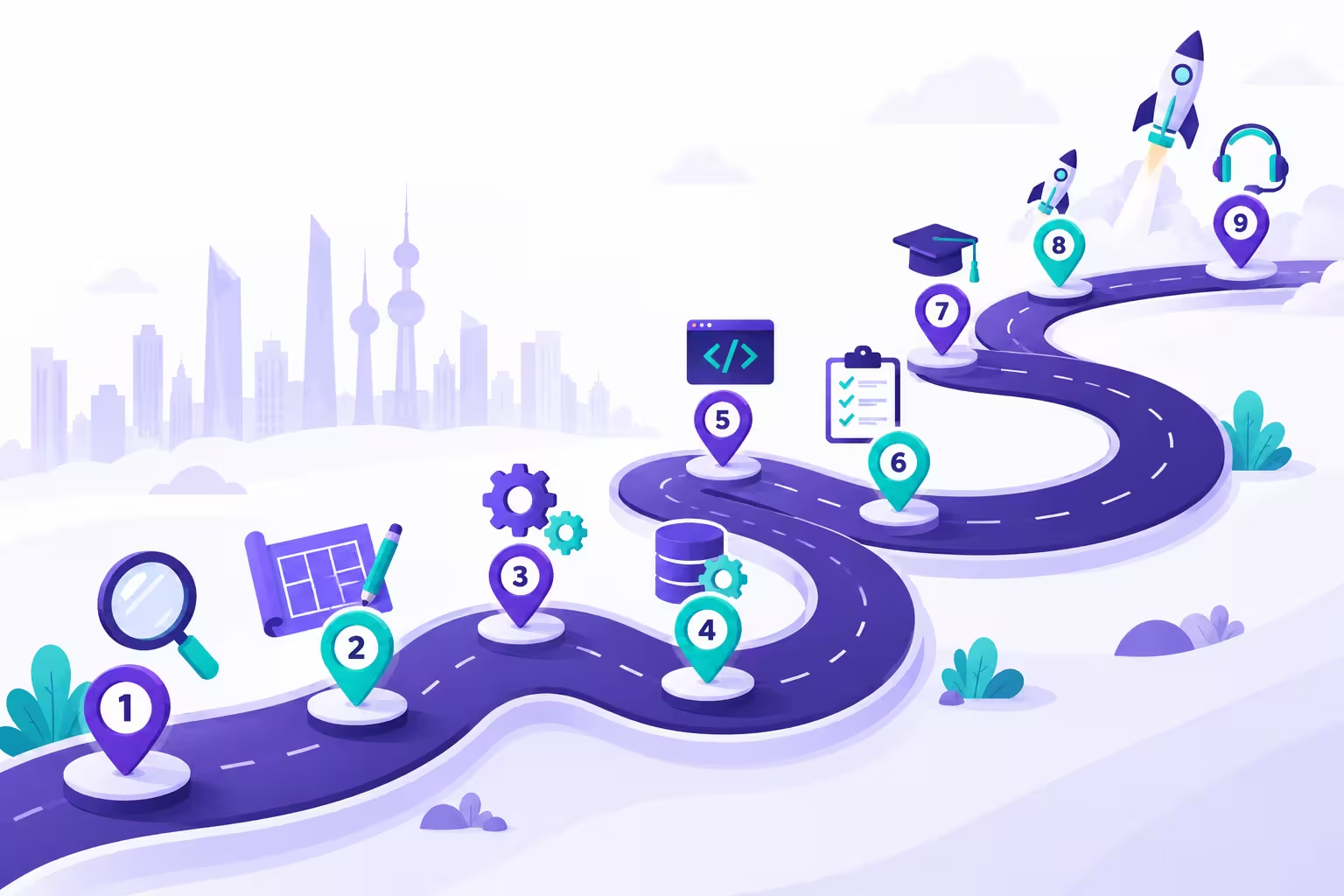
The 9 Steps of Odoo Implementation in Kuwait
Step 1: Discovery and Business Analysis
Your partner runs workshops with each department to map how work happens today: quoting, purchasing, receiving, invoicing, payroll, approvals and reporting. The output is a list of requirements and pain points, ranked by importance.
Step 2: Scope, Plan and Fit-Gap Analysis
Each requirement is checked against standard Odoo. What works out of the box is marked as a fit. What doesn’t is a gap, and you decide whether to adapt the process, configure a setting, or customize. A clear scope document and project plan come out of this step.
Step 3: System Design and Configuration Blueprint
The team designs company structure, branches, warehouses, chart of accounts, taxes, approval flows, user roles and reports. This blueprint becomes the reference for the build.
Step 4: Environment Setup and Configuration
A test environment is created and the modules are configured: accounting, sales, purchase, inventory and others in your scope. Arabic and English, multi-currency (including KWD) and access rights are set up here.
Step 5: Data Preparation and Migration
Clean data is the foundation. Customers, vendors, products, opening balances, stock quantities and open orders are cleaned, formatted and imported. Run test imports first, reconcile the numbers, then repeat before go-live.
Step 6: Customization and Integrations
Only the gaps that truly need it are customized. Typical examples are custom reports, document layouts, approval rules, and links to payment gateways, e-commerce, POS or other systems. Keep customization lean to protect future upgrades.
Step 7: Testing and User Acceptance
Key users run real scenarios from start to finish: a quote to cash cycle, a purchase to payment cycle, a stock count, a month-end close. Issues are logged, fixed and retested until each department signs off.
Step 8: Training and Go-Live
Train users by role, using your own data and processes. Pick a go-live date that avoids peak business periods. Many companies also freeze changes in the old system, do a final data load and run a short cutover checklist.
Step 9: Post Go-Live Support and Improvement
The first weeks are critical. Plan extra support, a quick-fix list, and a review meeting after the first month-end close. Then schedule phase two, such as extra modules, dashboards and automation.
Who Should Be on the Project Team?
| Role | Responsibility |
|---|---|
| Executive sponsor | Backs the project and removes blockers. |
| Internal project owner | Makes daily decisions and coordinates with the partner. |
| Department key users | Explain processes, test the system and train colleagues. |
| Finance lead | Owns chart of accounts, opening balances and reporting. |
| Partner consultants | Configure modules and guide best practice. |
| Developers | Build customizations and integrations. |
| IT support | Handles hosting, users, devices and network. |
What Matters Specifically in Kuwait
- Arabic and English: documents, reports and screens should work well in both languages, including right-to-left layouts.
- KWD with three decimals: check currency precision on prices, invoices and reports.
- Local chart of accounts and taxes: confirm the setup with your accountant and your partner’s localization.
- Regulatory reporting: if you will need to file financial statements in a structured format, such as XBRL, plan for it early so your accounts are mapped properly. See our XBRL guides for Kuwait for details.
- Payments: check KNET and local payment gateway needs if you sell online or at a POS.
- Multi-company and multi-branch: common in Kuwait groups, so design this structure at the start.
- Local support: choose a partner who can respond in your time zone and language.
Timeline and Cost: What Drives Them
An honest Odoo implementation Kuwait quote depends on your scope, so compare what each proposal includes rather than only the total.
| Factor | Effect |
|---|---|
| Number of modules | More modules mean more configuration, testing and training. |
| Number of users and branches | Affects licenses, rollout effort and training. |
| Customization | The biggest swing factor in time and cost. |
| Data migration | Cleaner data means a faster, cheaper migration. |
| Integrations | Each connected system adds build and testing time. |
| Edition and hosting | Licensing and hosting are ongoing costs, not just project costs. |
| Your team’s availability | Slow feedback and unavailable key users delay go-live. |
| Training and support | Budget for post go-live help, not only the build. |
Common Mistakes
- Skipping discovery and configuring from assumptions.
- Over-customizing to copy old habits instead of using standard processes.
- Migrating messy data and carrying old errors into the new system.
- No internal owner, so decisions stall.
- Too little training, then blaming the software.
- Going live in a busy period such as year-end close.
- Treating go-live as the finish line and ending support too early.
How to Choose an Implementation Partner
- Ask for relevant references in your industry and region.
- Look at their method, not only the product demo: discovery, fit-gap, testing and training.
- Check Arabic and local expertise, including accounting and compliance knowledge.
- Request a clear scope and itemized proposal with what’s included and excluded.
- Clarify support terms after go-live, including response times.
- Meet the actual team who will work on your project.
Frequently Asked Questions
How long does an Odoo implementation take in Kuwait?
It depends on scope. A focused rollout of a few modules is much faster than a multi-company project with heavy customization and migration. A proper discovery phase gives you a realistic timeline.
How much does Odoo implementation cost in Kuwait?
Cost depends on modules, users, customization, data migration, integrations, licensing and support. Ask for an itemized proposal based on your scope and compare what’s included.
Can Odoo work in Arabic and English?
Yes. Odoo supports multiple languages including Arabic. Confirm that your printed documents and reports are properly set up in both languages.
Should I choose Odoo Community or Enterprise?
It depends on the features you need. Your partner can show which modules are available in each edition and recommend the best fit.
Can we implement in phases?
Yes, and it is often the safest approach. Start with core finance, sales and inventory, then add other modules once users are comfortable.
What happens after go-live?
You should have hypercare support in the first weeks, a review after the first month-end close, and a plan for improvements and extra modules.
Final Thoughts
A successful Odoo implementation Kuwait companies can be proud of follows a simple pattern: clear goals, a tight scope, clean data, thorough testing and real training. Choose a partner who starts with your business processes, keep customization lean, and plan support beyond go-live so the system keeps delivering value.
Planning an Odoo implementation in Kuwait?
Talk to [Your Company Name] about your goals and request a free discovery session. Contact us here.